
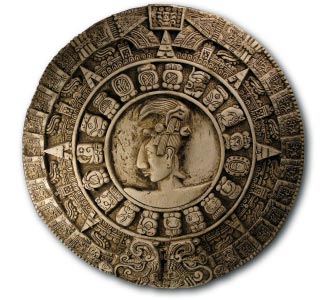
 The Mayan calendar has a long and deep history. But its premise is quite simple. Maybe not as simple as our Roman calendar, however. One of the defining characteristics of our Roman calendar is that it is based on various cycles. From minutes, to hours, days, weeks, months – we divide our calendar into increments that repeat on their own cycle.
For example, each hour has a first minute, each week has a Monday, each year has a first of January, and so on. However, it’s not every year that a Monday is also the first of January – this occurs only every seven years or so. The Mayan calendar works on a similar premise. As we examine the history of the Mayan calendar, we are given insight into its workings.
Table of Contents
Roman vs. Mayan calendar – Working in Cycles
 You might say that the Mayan calendar works the same as the Roman calendar, but with more complex, and overlapping cycles. A 52 year cycle on the Mayan calendar, for example, is called a Calendar Round. Now, similar to the way the first of January only occurs on a Monday every seven years or so, each day in the Mayan Calendar Round, referred to as a Long Count, is given a unique name based on a combination of various cycles.
Base 10 vs. Base 20
Unlike the Roman day, which is calculated using base ten, the Mayan Long Count is calculated using base twenty. What is base twenty? Just like our base ten system uses 10 numbers (zero through ten), the Mayan base 20 system uses 20 numbers (zero through twenty). So, while moving the decimal one spot in the Roman system changes our result by a factor of 10, moving the decimal in the Mayan system changes the result by a factor of 20.
Breaking Down the Mayan Long Count
The Mayan Long Count breaks down into the following units, where a kin is one day in the 52 year period:
- 20 kin = 1 uinal
- 360 kin = 19 uinal = 1 tun
- 7200 kin = 360 uinal = 20 tun = 1 kactun
- 144000 kin = 8000 uinal = 400 tun = 20 kactun = 1 bactun
- 13 bactun = 1 Mayan epoch
- 1 epoch ~ 5125.26 Mayan years
Subtracting from today, that puts the beginning of the current Mayan Long Count at August 11, 3114 BC, and the end at December 21, 2012 AD.
Does that mean the world will come to an end on December 21, 2012? We don’t think so but welcome your thoughts. Feel free to post your theories as a comment below on December 21, 2012, and how it relates to our world today. You can also read our article on the 2012 Planetary Alignment to find out why.
The Mayan 20 Day Period
The Mayan calendar is broken into 18 periods of 20 days each. They are outlined, along with their meanings, in the table below:
| Duran Time | Sahagun Time | Fiesta Names | English Translation |
|---|---|---|---|
| 1. MAR 01 – MAR 20 | 1. FEB 02 – FEB 21 | Atlcahualo, Cuauhitlehua | Ceasing of Water, Rising Trees |
| 2. MAR 21 – APR 09 | 2. FEB 22 – MAR 13 | Tlacaxipehualiztli | Rites of Fertility; Xipe-Totec |
| 3. APR 10 – APR 29 | 3. MAR 14 – APR 02 | Tozoztonli | Small Perforation |
| 4. APR 30 – MAY 19 | 4. APR 03 – APR 22 | Huey Tozotli | Great Perforation |
| 5. MAY 20 – JUN 08 | 5. APR 23 – MAY 12 | Toxcatl | Dryness |
| 6. JUN 09 – JUN 28 | 6. MAY 13 – JUN 01 | Etzalcualiztli. | Eating Maize and Beans |
| 7. JUN 29 – JULY 18 | 7. JUN 02 – JUN 21 | Tecuilhuitontli | Feast for the Revered Ones |
| 8. JULY 19 – AUG 07 | 8. JUN 22 – JUL 11 | Huey Tecuilhuitl | Feast for the Greatly Revered Ones |
| 9. AUG 08 – AUG 27 | 9. JUL 12 – JUL 31 | Miccailhuitontli | Feast to the Revered Deceased |
| 10. AUG 28 – SEP 16 | 10. AUG01 – AUG 20 | Huey Miccailhuitontli | Feast to the Greatly Revered Deceased |
| 11. SEPT 17 – OCT 06 | 11. AUG 21 – SEPT 09 | Ochpaniztli | Sweeping and Cleaning |
| 12. OCT 07 – OCT 26 | 12. SEPT10 – SEPT 29 | Teotleco | Return of the Gods |
| 13. OCT 27 – NOV 15 | 13. SEPT 30 – OCT 19 | Tepeilhuitl | Feast for the Mountains |
| 14. NOV 16 – DEC 05 | 14. OCT 20 – NOV 8 | Quecholli | Precious Feather |
| 15. DEC 06 – DEC 25 | 15. NOV 09 – NOV 28 | Panquetzaliztli | Raising the Banners |
| 16. DEC 26 – JAN 14 | 16. NOV 29 – DEC 18 | Atemoztli | Descent of the Water |
| 17. JAN 15 – FEB 03 | 17. DEC 19 – JAN 07 | Tititl | Stretching for Growth |
| 18. FEB 04 – FEB 23 | 18. JAN 08 – JAN 27 | Izcalli | Encouragement for the Land & People |
| 18u. FEB 24 – FEB 28 | 18u.JAN 28 – FEB 01 | nemontemi (5 day period) | Empty-days (nameless, undefined) |
Source: Wikipedia





USE THE FORCE WISELY
Okay I was not looking forward to the end of the world and were did NASA get the end of the world from and now NASA only God knows when that will come.
Do the Mayans include leap years? Because if not the world should have ended last year, in December…(another person told me)
All these theories are crud, the world will end tomorrow, because a friend and I are going to set of thousands of dollars worth of fireworks, end up overdoing it, and end the world.
(This is a JOKE to make people laugh, I am in no way serious, please laugh or ignore it as you see fit, and not nitpick over violence or other blown out of proportion things.)
Don’t you think if the Mayans could foresee such happenings that there would still be Mayans? lol…
Speaking of needing to read up before you speak – there ARE MAYANS living today all over the world but especially in Guatemala and other Central American countries.
Most people don’t seem to know how to research and educate themselves these days even with all the technology we have at our fingertips. It’s refreshing when you find those few people still left in the world who put in the little extra effort. This last week especially I’ve had to correct a number of people who thought the whole “planets aligning” thing was factual. That’s been refuted on countless occasions by most of the scientific community. NASA and amateur astronomers alike.
We are not of this earth.
Has anybody ever considered our leap years? Add those days in and we passed the date already. Didn’t we its all a scam people to get you to spend more money. They are selling fear as always.
We can’t just tell people the universe has its own time, that cant be changed!
Leap years are only a factor on the Roman calendar. The Mayan calendar has a different way of measuring years and does it more precisely, without the need for leap years. The final date was found using the Mayan calendar, then translated to the Roman one directly based on the position of the Earth, not just boxes on a piece of paper. Regardless of this, you’re right to say nothing will happen, just like the article explains.
OK if you think the world is going to end then you have very little time to get a mate and start screwing. You might as well go out with a bang!
I swear I will take good care of your stuff. Really.
lmao – I want the girl ones!!
It is a giant monopoly from all the governments of the world. They want us to spend money on stuff that will not help 99% of the population because if the world was truly ending we will not be here to even have to worry about material items. I mean why are you going to buy a Mayan calendar, clock, T-shirt or poster when it is going to be destroyed. What I know is that the government gets richer as we keep getting poorer. Planets will align and our normal days will keep on going, and everyone will still be poor except for the rich that never have to pay taxes. Like the President, Congress, House and all those in that general area. It is politics that they all they found something to scam everyone on so they use it. That is why all the little people have to pay 45-55 % of our hard earned money to the crocked Government
I would have to agree with you 110%. It’s all a big money grab if you ask me! Anything to totally drain you of your last penny; they wouldn’t miss that opportunity for the world! lol. I guess people are hoping that they might survive so having those items on hand would bring peace of mind. My Mom keeps telling me that all it is, is just “fear mongering.” Hopefully we’re right… But you’ll never really know. I just hope it’ll be quick! Best of luck to you!
Ancient Sinhalease (Srilankan) people built Mayans, Babylonians as the said “they came by sky from lion city, and gave us this technology…” Sinhalease developed a science that will never collapsed with nature. Then they went to outer space for expedition. They will come back and correct us if we use our nature wrongly.
Any way Buddhism can give all answers to future manners. There is a chapter called ” brahmajala suttha” in Buddhism…. that is the revelation of the world’s end and start.
Every body seems to forget that it is up to God when the world ends….not the Mayans!! And nobody knows when that will be!
The end of mankind will come in the common year 2280. At this time the world population will be well over 55 billion.
The world won`t end on 12/21/12, the Mayan calendar will just simply restart back at zero, after a full 220,000 days (366 years). It works the same as a car mileage gauge, flips through numbers, and when its ready, hits zero and restarts.
I don’t believe the Mayan calendar predicts doomsday, I have an alternative theory. We all know the story of the man who died for 3 days and was resurrected, the sun of Christ. Well, I’m not religious but, like most beliefs there’s truth in it. So I’ll try and explain.
Every however million years there is a planetary alignment. When this happens there is a 3 day apocalypse (that Jesus story) and the poles in the Center of the earth shift, this is the time of change, a new era arises, we move into the next stage of evolution in our brains. The Mayans believe in aliens or astronauts from another planet, and they are seen as Gods, the all mighty ones, the giants. When the planetary alignment happens this opens port holes in our solar system which leads me to believe that the Mayans wrote this calendar to let us know when their next arrival is.
The Mayan calendar isn’t the only historical thing that has came up with the date 2012. People have discolored thanks to carbon dating the engravings on Stonehenge.
And not only that, most sculptures in history are linked to the Sky’s, the pyramids are linked to the stars, Stonehenge lets you witness extraordinary changes in the solstice, it. Is an observatory pretty much.
If you disagree with my logic do your own research.
it may not come exactly on the 21st of December though as Mayans didn’t have leap years so their calculations may be slightly off.
When December 31 rolls around, everyone gears up for a party and suddenly it is January 1st and a whole new year. The world did not end. The Mayan calendar is a mix of astronomical calendars that repeat every 5125.26 years. December 21, 2012 is the end of that calendar period…or if you wish, a Mayan December 31st.
As to leap years, really? We created leap years and I would say our calculations are off, not the Mayans. They did their’s by the universe. We did our by some abstract math basing it solely on the amount of time necessary to revolve around our sun. I think the smarter we get, the dumber we are. I also believe the Ancients were very intelligent – even if modern man wants to call them barbarians or backwards. They lived in harmony with the land, not forcing the land to be something it was not. But that’s another battle.
See you all on Mayan Kin1 (December 22, 2012).
Oh give me a break. Here’s my theory: you’re full of crap.
I agree with Gemma Shepherd, 98% have done my research too. The remaining 2% is when that doomsday will finally come. Its better not to prepare for it. I’d rather die than living after the doomsday. Imagine the place you will live in, back to stone age again!
I just really appreciate what you have to say. I agree with you 98%. May the force be with you!
Well my predictions are that the world will end bause the Mayans predict it. I love you all!
Too bad the Mayans didn’t predict it
it was never said that the world was going to end. The whole calendar was a countdown to the return of the Gods.
First how to say this, Mayan calendar is God’s equipment through this calendar. God announced your world to be come to an end (21-12-12) only one man to save our world (God).
If 20 kin = 1 uinal then 360 kin = 18 uinal, not 19.
20×19=380 *20×18=360
This is not the case on a Leap Tun.
No proof so continue our aims and goals. If we are thinking about such information which will spoil our present precious days. Nothing wood Happen. Happy New year 2013 friends.
the Mayans should have put cute little kitties or watercolors of rural America on their calendar! They would have sold so many more! Pyramids, glitter, ponies, soccer, hats with feathers, Kung Fu challenge, William Hung and Ricky, don’t you lose my number.
The Aztec and Mayan Sun Stones are compasses. They were originally placed on their backs in vast market-like plazas like giant stepping stones. The 20 astronomical symbols around the center are for navigating at night. They faced the direction of each constellation in the sky at the time they were placed and knowing their original location would allow for them to be accurately dated based on this. The triangular markers on each ring mark out 90, 45, and 15 degree increments around the face to navigate during the day by taking a bearing standing on the center and making ‘radial arms’ with the sun to navigate. Rather than 18 x 20 it is 18 x 10 x 360 = 64,800 ‘grid vectors.’ Please see the Carl P. Muncks ‘The Code’ – it is in print and has been given to the United Nations.
Time has been, will be and will continue. We realize time as – one trip around the sun is known as a day, we call 7 days a week, 52 weeks a year. Once we had a calendar with only 10 months, July and August were added (after Julius and Augustus), October was actually the 8th month. What happened to change this? Questions to ponder. When was the beginning of time? Is our perception of time constant? If our universe ceased to exist, would time continue? So little time, too many worries…
a trip around the sun is a year….
Time is a human construct and only has relevance to the human experience. Once humans have disappeared, so will time.
Sure the word “time” is. Time itself isn’t a construct. If we didn’t exist would mountains exist? would elements exist? would height, width, measurements? Yes, they would all exist. They just wouldn’t have definitions or words to them. Time is a dimension just as height, width and depth are. Those will all still be there, there will just be no perception of them without something to comprehend it. So no, time will never disappear.
I agree with the others. Just like we have 12 months in a year on our calendar, they happened to have thousands of years on theirs. It’s just resetting. Chill.
Why do Mayans have Duran time and Sahagun time? What is the difference and meaning of the two? To me each looks similar to our zodiac? Why two zodiacs, so to say?
The Mayan’s did not Have/believe in leap years, therefore, the world would have ended years ago.
You must not have a very good understanding of the Mayan Calendar, even after reading this article. The Mayan Calendar is so accurate, it doesn’t need leap years to make up for anything.
She does have a good point though. It makes perfect sense to me.
I’m really confused with this whole situation. Who are the Mayans and the Aztecs? I don’t want to believe the world will end but hey you never know. I hope not. But I’m really concerned can anyone explain?
The Mayans and Aztecs were Indians native to Central/South America. The whole debate revolves around the fact that the Mayan calendar stops on December 21, 2012. First of all, the would have no way of knowing when the world would end. Second of all, the Mayans had no concept of a leap year (an extra day in February every four years since each day is not exactly 24 hours long, more like 23 hours and 59 and a half seconds. After a while it builds up, so the extra day is to make up for that time). So for them, December 21, 2012 was a very, very long time ago.
all of you are retarded… I know who owns this world and they clearly say it’s game over this year…
Oh no, our calendar is ending on December 31st. We are going to die! Okay, how many times has this happened? Well, in A.D it has happened 2011 times. Our calendar has ended 2011 times. And the Mayan calendar is ending on December 21st. On December 22nd, Happy new year Mayan calendar! Simple as that. It is just another calendar that that ends a recycles, like our 12 month calendar. Nothing big.
What do you mean “what is the point in existing if we’re all going to die”? Everything dies, everything that lives dies! That’s a really stupid thing to say.
And either way, 2012 was not predicted to be the end of the world by the Mayans, it was the Aztecs. The only reason their calendar stopped at 2012 is because that is when their calendar would have reset. The world was never going to end that day. The Aztecs thought it would because the Mayan calendar ended then. The Mayans never once prophecies the apocalypse in any of the work we have of theirs, it was the Aztecs some 500 years later. The two are unrelated.
I believe the Mayan calendar is a bunch of crap.
What is the point in existing if we’re going to die?
Well we exist because that is what our creator wanted for us from the beginning. Unfortunately we have all these different religions saying they are the way…and miss guiding millions to the point of separation from the supreme being.
The Muslim believe in Allah, Hindus have many gods, but believe in one major god, New age believe in self supremacy, Buddhists believe in finding enlightenment within themselves and Christians believe in a one all mighty God Lord Jesus.
So pretty much :
Hindus acknowledge multitudes of gods and goddesses.
Buddhists say there is no deity.
New Age followers believe they are God.
Muslims believe in a powerful but unknowable God.
Christians believe in a God who is loving and approachable.
So until you are in the right path…you won’t know your existence. We are here for us. To love one another. To share our lives with one another. And to love the Creator, no matter what religion you are in. Because just like before, horrible things will happen on this earth and we will begin again…so all we have on earth is ourselves. You me and the rest of us. God or Allah or what every you call your Supreme Being, is not going to interfere. You may not like it, but it is the fact. You live in an electric-mechanical-biological body. It can be programmed and I am sure, re-programmed for anything just about. Don’t believe me…ask Tony Robbins and his NLP system…teaches people how to re-program the way they think about life and themselves. So what makes you think your God will not change your program.. think clear here.. You are THE CREATED. Even if you don’t believe in a God.. you are still THE CREATED PERIOD! Even science proves we are created…
Now understand this. Your brain is a supercomputer that sends everything you are doing back into the ether, where it is recorded…after that, it gets sent to the paper handlers who sort out the importance of the messages, that is presented to the Supreme Being so that He puts the energy of it into the cosmos of the universe where it becomes reality for you. This is what Christians read about “Ask Believe You Have Received It, And You Shall Have It”. Of course it is but one way to put that energy there, there are others that you have to learn.
So why do you exist? To make life what ever you want it to be. Because as long as you are following the placed laws of the universe, you will succeed in any task you seek. Trust me. I have put this to the test. Just understand that rules are rules. But most important is to follow them. What are the simplest rules.. the simplest rule is to be educated. Let me let you know what education is according to my reasoning. An educated person is one who’s senses are refined, but not all senses become refined. Some are too course to be refined. The main base of education is one’s self respect. Anyone lacking self respect cannot be educated. The basis of self respect is the willingness to learn, to do only the things that are good and right to believe only in the things that can be proved to possess appreciation and self control. If you lack the willingness to learn you will remain as a brute and if you do things that are not good and right you will be a low person and if you believe in things that cannot be proved any feeble minded person can lead you and if you lack appreciation it takes away the incentive for good doing and if you lack self control you will never know the limit. So all those lacking these characteristics in their makeup are not educated.
So if you have doubt then put it to the test and see the result. The ancient texts say to put “everything” to the test. So go and do so. It is a suggestion to satisfy human doubt! And trust that there is a supreme being, after putting that one to the test, you find what is and isn’t trust me.. you will find him.. he is there.. not physical that’s for sure.. but his presence is undeniable.. science calls him dark matter or dark force and so forth. they can’t measure him or nothing.. they just know He is there… he is even part of Quantum Mechanics equations because his force is measurable, but not his sustenance.. so there is unlimited measure when it comes to his force measures and no measures for His existence. Boy, and you thought you had trouble figuring out your own existence. hehe 🙂
Ok, I hope I helped.
Peace,
Johnny Quest.
The 52 year cycle is actually 52 days. A day = a year. It’s Deja vu. You dream of the future. I get it all the time. so for example today happened 52 days ago in your dreams or thoughts because our mind and thoughts are telling our eyes what we see
Really interesting post, I get a feeling of dejà vu pretty frequently. Could you explain a little bit what this means?
I believe the Mayan calendar acts just like our watches. If you notice our clocks only go up to 12, then resets and starts back from one and works its way back to 12. Maybe when dealing with time 12 is the highest we can go up to. Even the Mayan Calendar goes up to 2012 December 21. In other words 12/12/21. Just switch the last two numbers around and you got 12/12/12. I think the calendar will just restart.The calendar will just restart and we will go on with our normal lives, but then I could be wrong. Maybe some huge event will happen or maybe the sun will be at just the right angle and one of our planets will be at just the right spot and some light will be seen from earth or maybe nothing will happen. We can’t do anything, but just wait and watch.
Hey, that’s when its my birthday is: 12-12-12.
There is nothing to believe this prediction. The world is not going to end. Trust God that nothing will happen to you.
We should believe on Sai.
SAI SARVAGYA HAI.
SABKA MALIK EK.
End of the world? What the heck. There’s nothing you can do when time comes.
But you can do things before it happens. Don’t just exist, love and live…
I believe the meaning of all this is people having more self awareness, people will become more awake and realize that everything is connected. Death,life, are one in the same. Why do you think that the Mayans were never found? They became awake.
In Egyptian times they believed the true warriors had to be put through tests. These tests where physical, mental and emotional. They found ways to trigger part of the brain we now don’t use. We are blinded by the truth. We go through all these tests in one day. The spiritual,emotion and physical awareness will happen when we enter this new age. The people that refuse to accept this will be lost.
I sure hope so. That would be beautiful! Have a very Merry Christmas 😉
I really do not agree with all these stories.
According to God, no one knows about their end. If that is the case, how can somebody say that the entire world is going to vanish just because of the predictions made by humans? I request each and every one in this world not to believe in such trash news and do not waste valuable time. PUT YOUR TRUST IN GOD.
You say according to God, have you been speaking with him lately? People like you amuse me you don’t listen to factual evidence of these so called stories yet you have in your mind that we should trust in God that you really don’t even know exists….you are contradicting yourself…Truth is not one human being know’s what will happen to them after death and everyone has their theories and beliefs and yes you can put your trust in God if you wish but don’t discard these “stories” as you put it, at least there is hard evidence that they existed.
First off, I laud you for having your own opinion, however scientific evidence, and the fact that everything is so ordered, and complicated kind of insinuates an intelligent design behind our reality. Moreover, if this world is all there is to look forward to, then oblivion after suffering and struggling, that is really depressing isn’t it.
Just some thoughts, from one intellectual to another.
shut up and keep your religious hating thoughts to yourself, thanks.
Trust in GOD??
The world WILL not vanish!
The galaxy WILL be entering a new Era.
The galaxy WILL be evolved.
The Mayans predict that the galaxy is run by cycles.
The last cycle was the end of the dinosaurs.
This cycle is the START of humanity.
GOD has nothing to do with the cycle of the galaxy GOD was just a person who was a Teacher of the Spiritual world.
The world is just entering a new cycle.
So if a scientist predicted that a comet/asteroid was coming to hit the earth we shouldn’t believe it? I’m just saying for a human to predict an astrological event is possible. I admire the Mayans hard work to document the cosmos. Do I believe the world will end in 12-21-12? No, I don’t entirely. Is it possible something could happen causing a natural disaster? Yes it is but I don’t think humans will become extinct from it. How you may be wondering? Every year on the winter solstice, our Sun has a Declination of -23.5 degrees, and a Right Ascension of 18 hours. But what makes the alignment of 2012 special is how this alignment occurs relative to very distant stars. On December 21, 2012, the alignment will be right along the plane of the entire Milky Way galaxy. This precession of the equinoxes goes in a complete circle and happens only once every 26,000 years. In other words, the winter solstice moves 360 degrees every 26,000 years, or 0.01 degrees each year. This only happens once every 26,000 years so if scientific Adam was traced back 60,000 years ago and we didn’t go extinct the last time this event happened, I doubt we will this time.
I’m not trying to disprove God. This is my opinion only from my research.
Any comments to this post email me tlokck@hotmail.com
The world is going to end, but if you believe in Jesus you will go to heaven. If not God will give you one more shot at the Earth when the devil is ruling and it will be tough if you don’t believe in Jesus. So get saved by Jesus who died for your sins and ask him into your heart before it’s too late.
I can agree with everything you said EXCEPT the fact that the world will end. The world will and has not ended. Only God knows when it will happen. the Mayan calendar was just restarting. (Sarcastic joke). Why do people think that the world was going to end in 2012 when Marty McFly traveled to 2015.
Why must you Christians always try to push your beliefs on everyone? So what if you believe in Jesus as a savior and I don’t? I’m not trying to convince you otherwise, so please don’t try to shatter an entire people’s dedication to the cosmos on a religion they never encountered. The Mayans knew black holes existed then and we didn’t confirm them until the 90’s. You have to give them credit for that. Their near perfect precision in documenting astrological cycles has not one thing to do with Jesus so please just stop.
The world never ends, it goes through some natural disasters some of which we are already seeing, but it does not end. As for the second shot at earth, again incorrect, those that do not believe will “go to hell” the sinless believers of which there are only 144,000, will go to heaven, the rest of the believers alive and dead, will be raised to live on the earth WITH God, in the new Jerusalem here on earth. That is what it actually says, now the tricky part is that this prediction is a dream, and as we all know dreams are subject to interpretation. So how this will actually transpire and when is still the mystery, but I do believe that it is close, the signs are blatantly obvious if you get even an narrowly open mind.
So coming from a non-believer this was nice to read. Someone of that faith admitting to dreams needing to be interpreted is so refreshing. My question is when did “he” have the dream? 144,000 doesn’t have to represent people. We are all kin to each other. This refers to people but kin also refers to a 1/13 of an epoch, which translates into about 364 years. If you take the date your religion broke out and add 364 years you get about the answer someone close to the top came up with. “End of Calendar on date in the year 2280.” Since we really can’t be sure when the Mayan Calendar started we can’t predict its end just knowing how long an epoch is. I still love the romance of this Friday coming though and our world does feel like it’s in a big $#!^ hole right now.
On a side note. Everyone who talks about leap years having to do with anything are very mistaken. The Mayan calendar is based on astrological events. So is our modern calendar. It takes 365.25~ days to go around the sun. Instead of having a long December 31st every year we have an extra day every 4 years. It’s actually so it aligns better with the Mayan calendar. Maybe they weren’t using it at a base when they created it but the principles were similar.
All creation is because of the big guy upstairs,…. Chris saved me.
Cool. I hope you thanked Chris.
But of that day and hour knoweth no man, no, not the angels of heaven, but my Father only.
no one know the time and hour that god is going to come, but he never said that we wont know when the disaster will start. December 21st 2012 might not be the end of the world but it can be the day that a lot of people die.
This is a stupid thing to say because a lot of people die everyday anyway so it won’t make a difference
Personally, I think this is quite obvious to any intelligent onlooker anyway. I am in no way troubled or overly concerned by these predictions. I also do not give in to the gloom and doom purveyors who think that after 12.21.12 time will simply end. After all, many people have predicted the end of the world throughout the centuries and we are still here.
It is also quite obvious that many nations of the world are currently facing serious problems. It seems that the current institutions are no longer able to provide the type of help or assistance they once did. Some people think that many of these institutions never did, but that is another story! The economy of most major Western nations seems to be crumbling. There is a massive amount of debt and it seems like everything is focused on consumerism.
I think all of this talk about the end of the world is gaining strength in popular culture is because people instinctively feel that it is time for a change. Many people feel like they need new solutions to these problems. If one is not careful, these feelings can give way to a sense of foreboding. I think that the Mayans themselves seem to have an innate understanding of this (and yes, there are still Mayans alive, along with a council of elders that makes infrequent public statements on the times). Maybe this is why they are saying not to fear 2012, but to embrace it and to embrace the change that is coming.
It is my personal belief that the current political institutions cannot stand for much longer. Maybe even the whole idea of a modern nation is an idea whose time has passed? When you really sit and think about it, you are led to the thought of what a government or a nation is good for.
As I look at the news today and think about all of these predictions for the end of time, I wonder how other people felt during periods of great change. Maybe people at pivotal times in history did not even realize what was going on around them? I think this quite is likely, since today very few realize what is going on around them.
When the Roman Empire fell, it certainly did not just cease to exist. There was not one day when the Empire was here and people followed her laws, and then the next day she was gone! No, it was likely a time of great change and even confusion. It was a period probably much like today. The people did not realize what was going on; they did not know what to do or how to react. I am quite sure that many of them felt like the world was about to end. Maybe a few actually did predict the end of the world was upon them.
All this said, the Mayan calendar is really about how we react to time and the changes that it brings.
Another thing that I (and probably many other people) find quite fascinating about the Mayan calendar is that it is not just one calendar. Rather, it is a series of many different, sometimes interlocking calendars. Each unit of time seems to sort of flow into the next. Of course, the words and their units of time, as well as their ancient meanings have been lost to modern science.
Despite all of this, I find it fascinating how many people today are still interested by this calendar and even the Mayan culture. Certainly, this was an ancient race of people that had an incredible amount of knowledge and foresight. Many have asked the question of how this people were able to come up with such a detailed and relatively accurate set of calendars. After all, these calendars are very old. They were created at least 3,000 years ago (and probably much earlier, according to many experts).
Not only that, but these calendars also seemed to have made surprisingly accurate predictions of the future. The Mayans themselves were certainly aware that it accurately foretold the coming of the Spanish Conquistadors in the 1500s.
It also seems to me that people today tend to focus on only the more sensational aspects of things. This is certainly true with the Mayan calendar. Unless you have been living under a rock for the last several years, you are likely aware of the prediction that the world will come to an end in December of 2012. Maybe you have even seen a movie with this as the main theme.
Certain people have sensationalized the fact that the Mayan long count comes to an end on December 21, 2012. According to their calendar system, this marks the end of an epoch, which represents 5125.26 Mayan years. The epoch is the longest of all the intertwined calendars. Since there is nothing after this, many people have inferred the meaning that it will lead to the end of time.
To me, this seems a bit ridiculous. Not even the Mayans themselves are making these predictions. In fact, they say that after the current epoch ends, a new epoch will begin. The Mayans saw time as periods of change. What they are saying now about 2012 and all this attention is simply that the year 2012 and the time surrounding it will be a period of great change. That this change will lead to much social and maybe even political reorganization.
thank you for such an intelligent response, so nice to hear for a change. I agree with all you say especially the part about 2012 being a year of great change both political/social etc.
Why is it , every time there is an intelligent conversation, the Jesus freaks come out of the wood work? Don’t you people have enough dogma to keep you busy? This article was well researched and presented. The same type of people who believe Jesus will come back are the same type of jug heads who started the doomsday bullshit in the first place.
Please go count rosary beads instead and leave the intellectual discussions to those of us who really do wish to understand history and its place in the modern world. Praise to the creators of this site, and may they continue to provide education to those willing to learn.
I am a Christian and am really enjoying reading the history behind this! But, please do not lump all Christians in the same bunch, and perhaps do a bit of research on your own before making an uninformed comment such as counting our beads? Genuine “born again Christians” do not pray the rosary. That’s praying to a false God. Mary was a mere mortal such as ourselves.
Thank you!!
I, as a Christian, am finding the history quite interesting. But before you open your mouth about Christians I suggest you do some research. True saved Christians do not pray the rosary. The bible does not want us praying to anyone but God, including a mere mortal such as Mary. Please do not lump all Christians into a bunch. Thank you! 🙂
WARNING: I’m about to burst your doomsday bubble for all you doomsdayers out there.
There have been about 514 Leap Years since Caesar created it in 45 B.C.. Without the extra day every 4 years, today would be around July 28, 2013.
Also, the Mayan calendar did not account for leap year… so technically the world should have ended 7 months ago.
So if you are taking a day away how do you end up with a date that is further in the future nice math skills bro. Today would actually be somewhere around July 9th, 2011 if there was no leap year. And the Mayan’s year was only 360 days so that’s a whole 5 days missing from our calendar year. The world isn’t going to end its just their calendar is going restart that’s why its in a circle.
The Mayan calender was actually so precise that it took into account for our leap year. I have studied this for years, so please make yourself aware of the facts before hand.
Somehow your theory makes no sense to me. If you are taking away the extra day added, wouldn’t this put us behind and not ahead? So what you’re saying is with the extra day added we are really living in the year 2013. Would this be correct?
I’m scared to die. I’m only 13 years old I wish I could live to see 38. God please let me live longer.
Yeah except their calender works off stars, not the calender we use today. So leap year doesn’t factor in and it won’t end.
While I am inclined to believe you about the leap year theory, but if March should be July then how do you account for the absolute of the changing seasons? You must admit the weather we have in March is very spring like and the weather we have in July is hot. So to say that March should be July if we did not have leap year is the fault of Romans, well the Mayans may have already figured this out. So you are saying that the Mayans with all that they knew did not factor in something to ensure the days, years, seasons and solsistices would line up. While I am not on the doomsday day wagon, your argument has some holes in it.
He was a dictator and military strategist, not father time. He who created the leap year has no connection to the Mayan calendar since they are two different methods of time keeping. Also one was created at 5k bc while the other was nowhere near that.
If God really wanted the world to end he would do it now or the next minute or next week or next month. In the Bible it says, “you will not know the time nor the day when I will come back for you” meaning be ready for him whenever. If you believe in Christ Jesus as your savior than there should be nothing to worry about. Some dumb scientist sitting in his lab had nothing better to do than come up with something to scare the world. So take all the mystic mumbo jumbo and actually look at the calendar…the thing just starts over….not ends.
I had a really good laugh at your post; so typical of you Christians. Your “god” is as much mystic mumbo jumbo as any other culture’s “god” because there is no scientific evidence of any “god”. Jesus was not the son of God; he was born, was wiser than his time, and was like many other “ascended masters” such as Buddha, etc. In his case he was killed by religious zealots. All religions have zealots. And all religion can be considered mystic mumbo jumbo.
The fact that the above comments involving CHRIST, and your insistence on insulting the writer lets people know you are just afraid of the truth. What’s funny is people truly believe that all this just happened because two rocks decided to collide in space. Seriously? All the New Age, Mayan Calendar, Awaking the Spirit stuff is just another step in bringing about the NWO and One World Religion which will be overseen by the Anti-Christ. The Anti-Christ will rule for 7 Years. This process is already being staged and anyone who can pay attention to the world around them can see this. The city of Damascus in Syria is the oldest inhabited city in the world and the bible (Isaiah 17) predicted it’s complete annihilation which has yet to be fulfilled, Damascus is 40 miles wide and until we had nukes this task of “complete annihilation” was not possible. However, it has been made as simple as a press of a button….should they seek refuge in Israel you can bet your rear this will be fulfilled. Also the U.S. created 800 billion Americans backed by nothing and sent it to China….seems the crashing of our dollar will be deliberate in order to bring together currency. The Mayans couldn’t predict the end, if they could they would have stopped their own demise. Perhaps, however, they had the ability to see change. We are 3,000 years older and our wisdom has made us blind and stupid. The signs are EVERYWHERE including in these rather ridiculous comments, yet people still refuse to open their eyes. Ever heard of the “Illuminati” they originated from the Royal family…guess who takes the throne when the 86 year old queen succeeds?…that right Prince William…( Will-I-Am) and they claim to hold the bloodline of the Holy Grail. Before u go insulting the Christian faith, perhaps u should research your heart and your beliefs and lay off the insults until u have a few facts of actual gained knowledge.
First off, The Big Bang Theory doesn’t say two rocks, it says a collision of two masses. Secondly, it’s in no way proven, in fact the view of the entire scientific community is that of all the theory’s they’ve come up with so far, it is the most likely. There are also theories that say that if one point in space has a temperature of 15 trillion (I think it’s that, point is it needs to be very hot), a new universe will be created right there.
Moving on, even if the Maya (BTW that’s the noun, Mayan is the adjective) could have predicted their downfall they could have done nothing, they were still quite literally stuck in the stone age. The Spanish on the other hand had guns, nice shiny ones with bullets.
Now your points on Damascus, while we have nukes, and pretty buttons that make them go boom, I fail to see how that has anything to do with what is currently going on there, people are fighting for the right to live safely in their country, not to “annihilate” it.
Maybe I’m blind because I fail to see any signs of an Anti-Christ, and maybe you want to check your precious bible, because the books that make it up have been copied by hand so many times that there are parts that sound nothing like the original. An example, the story of Jesus and the woman taken in adultery, was made up by a scribe copying Johns Gospel. There are earlier copies of that gospel (I think around 150 A.D. is the earliest copy we still have, there’s 100 years of potential errors there too) that make no mention at all of this story. It just pops up a few hundred years later and the church says sounds good, lets put it in anyway.
I will admit there are some “rather ridiculous comments”, but most of them come from the people shoving their ‘GOD’ down everyone else’s throat. I’m going to ignore your Illuminate comment because honestly it’s one of the dumbest things I’ve ever heard. HE HAPPENS TO BE NAMED WILLIAM, GET OVER IT. It’s called a coincidence, just because when you type NYC into Microsoft Word using Wingdings doesn’t mean that New York is all for killing Jews.
“Wisdom is a deep understanding and realization of people, things, events or situations, resulting in the ability to apply perceptions, judgments and actions in keeping with this understanding. It often requires control of one’s emotional reactions (the “passions”) so that universal principles, reason and knowledge prevail to determine one’s actions. Wisdom is also the comprehension of what is true coupled with optimum judgment as to action.” THE DEFINITION OF WISDOM IS CONTRARY TO YOUR STATEMENT, IF YOU ARE WISE IT CAN NOT BLIND YOU OR MAKE YOU STUPID.
Lastly, while your ‘God’, or anyone else’s for that matter, can’t be disproved and probably never will. It can’t be proved either, and never will be. I would rather spend my time actually doing useful things rather than waste my time worrying about some mystical end that will kill us all.
Then why are you wasting time commenting on here in the first place?
the Mayan calendar is round for the circle it makes when it starts over. There is no last “page”. Just like the earth is round and you keep circling. All the fools that thought they would fall off the edge are back as doomsdayers. Good luck mankind, God knows you need it.
Actually, the long count calendar is not round at all but a rectangular “block”, so it does not rotate or gear with the other circular calendars per se. This is one of the probable reasons for the speculations regarding end times…… why isn’t it round like the others if it does just signify “cyclic timing”
Food for thought.
The world isn’t going to end in December 2012. All they have to do is turn the stone over to the other side and continue on…
God’s purpose was not to let us die. He wants us to listen to what he says. The world won’t end!
I don’t think the world would end either but I do believe we are bound to expect impacting changes on this theorized day in count. Perhaps our number decreasing based on it making it the end for some individuals but not yet the world and not yet every individual… And I strongly believe we were born into existence with a cause. But our choice of free will from the God itself leads to whether we choose to fulfill our purpose that he has set for us or allow ourselves to be manipulated and weakened by the temptations…
There is a saying that only the strong survives and I don’t only mean the physical but mainly the mental aspect. If God is creator of all things then he must have created what’s past this Earth and what lies within our galaxy and beyond the stars… Or is he only the God of our Galaxy?… our planet? our individual belief of what and who is God? I believe there’s got to be a Creator or a God but if he is too busy creating a masterpiece how is he able to watch over all his children?… His servants!… Which history says that not all his servants were as obedient. But the Gift this God has is the fact that he can see past it all into the heart and the soul and it is there that he would know if we do mean what we say. Obedience is all he ever asked of us and we failed him when we bit the apple. We continually keep disappointing him but not everyone is as strong of a believer and weak minded. But Jesus, who was indeed a servant to who God could trust in, proved the value of our existence and that is why we are here today and not to fully end. Jesus saw potential in us… If you are a parent yourself you could understand my view and his.
Not to say your explanation is confusing, I have read other sites that have explained it in a similar fashion and I still try my best to understand how it works. What is really confusing is, here we are, modern man trying to understand something made using mathematics, astrology, and science by someone with a stone hammer and chisels. I could be wrong but I think they had help.
They had help from Ancient Aliens!
“i’m not saying it was aliens…but it was aliens.”
Are you thinking of extraterrestrials? If not, apologies. If you are, yes, that’s an interesting topic. But we should also be careful not to assume a lack of intelligence within our ancestors. Some of the greatest philosophers and scientists stem from civilizations in the past.
Why are y’all putting this on the Internet? Kids are really scared and they really think the earth is really going to end on exactly Dec.21, 2012 🙁
Then don’t be looking up stuff like this duh. Put a parental control on your internet, you should control what your kids watch.
Trust me, it never will happen. That was not gods purpose
You don’t know what god’s plan is dummy
Because I know exactly what god’s plan is… look in the bible…tead it cover to cover and you will know the truth. The world will not “end” but all Christians and children will be taken to heaven and if kids are looking this up then they need to know that no matter what if they accept Jesus into their hearts they will be forgiven and taken to heaven.
Once again, you do not know God’s plan even if he were to read the bible cover to cover, you would not find any reference date to when the rapture will happen. Do not try to assume what God means because you will be sadly mistaken and look like a fool. God does not tell you his plans for a reason.
Secondly, you assume who will be “raptured” again not a good move on your part. For you are not God and you do not know who will or will not be raptured. I’m not saying that I know I’m saying that you do not know so do not pretend that you do, last time I checked you were not God.
Thirdly do not be so fast to know God, you do not know God and you never truly will until your judgment day. Finally my point is this, our existence in this world is a test for all people, the doomsday will not happen until every spirit has had the opportunity to be tested, this means that when we come to the last days there will be no more babies born.
Once again, the bible does not ever refer to the rapture. Don’t play God son not a good move.
I’m a Dutch kid and I’m really scared it’s gonna happen!
If it helps put your mind at ease, we don’t think the world is going to end, and we mention that if you read the whole article. That being said, the number one proponent of fear is the lack of knowledge or information on topics. That’s how racism, bigotry, and other forms of hatred and fear flourish. Given that, the more information we can gather and share on a topic to dispel fear and misinformation should help us be more knowledgeable and comfortable with a topic.
We were all kids once. If the information is out there, and it’s not discussed with your kids directly, they’re probably going to find out anyways through an unknown, often uninformed source. Just like the “birds and bees” talk you have with your kids on having children/ birth control, etc. it’s important to educate your children before others do.
As far as the Internet is concerned, if you’re concerned about your kids browsing safety, we recommend looking into some family safe browsers and parental control options such as CyberPatrol.com or NetNanny.com (these are just examples, there’s plenty of others out there).
Your explanation might have been better served by translating our calendar into the Mayan Long Count. Instead, you have confused people, it would seem, by just going Kin = Julian day and then counting out. You may have reached more people by comparing our calendar components and translating them.
Like, “the Mayans had days that they referred to as Kin, and months called Uinal, each made up of 20 days organized into 360 day years made up of 18 Uinal” or something like that. Charts tend to confuse people (even those of us familiar with the breakdown), especially when organized from the standpoint of the logic we are trying to learn and you don’t check your work all the way.
It’s like writing a Spanish-English dictionary for an English speaker with the important info in Spanish with incorrect grammar and conjugation. Nonetheless, I was able to use your chart to reorganize what I already knew and teach it to others.
I don’t get this at all. Please work on making it more simple.
god said “No MAN know the day, year or sec my son will be coming back! not even him!”
That’s why I’m not including this website in my research!
I would say that’s the problem with you over-religious folk. You blindly follow your dogma without doing your own due diligence (homework). Ironically, it appears that by posting here you must have at least read part of the article, and therefore implicitly included this site in your research. We’ve also noticed that you didn’t capitalize “god”. Oops!
Huh…… I’m so lost
Go to MesoAmericanCalendarStudies.com. There you will be given the details you need to understand this wonderful mechanism that is so poorly understood by those who pretend to know the details. They truly do not get it, that is why you are lost.
Hi. It should be 18 uinal not 19! Then it will be 20*18 = 360 kin. Some bad mistakes! But thanks after all.